Designing Oars for the Salt Bay Skiff


 Locked


 
|
This post was updated on .
It has been Riverswest's practice to buy from Caviness the oars it furnishes to the families who participate in the annual Family Boat Build. Commendably, Riverswest wants to hold the cost to the families at $450. But what used to cost $40 for a pair of 6.5s has now become $70. Were those oars good oars, that would be money well spent in terms of labor saved that would otherwise have to become part of the kitting process. But they are junk for their being so thick in the blade and so over-built in the lower loom that 2-1/2 pounds of hand effort is required to lift them out of the water for the recovery stroke, rather than just the 10 ounces (+/- 2) of a properly designed recreational oar. By my estimates, a pair of indexed, balanced, and properly-geared flat-blades could be built and ready to paint or varnish for under $25 and under 4 hours of labor. So I'm going to use this thread to explain how, beginning with some rowing basics.
Boats and oars are no different than bikes. Everyone knows that a bike is adjusted to fit the rider, not the other way around. Boats and oars are no different, and they lend themselves to a lot customization, such as thwart height above the bottom (hence, leg room), oarlock location (hence, a comfortable reach), oar length/blade style/gearing ratio (hence, a comfortable effort), etc. So let's begin with grip shape and point to some commonly found shapes that are Very Bad Choices. Bad Choice #1 is a "broom stick" grip. Despite Phil Bolger's preference for such a grip, and he was a very experienced recreational rower, this is a grip shape that most people should avoid, because it forces the hand to be positioned unnaturally. To see how this is so, stretch out your arms in front of you and close your fists. Now rotate your wrists so that your palms are parallel to the floor. Feel the strain in your forearms? Row with broom sticks for grips for even just ten minutes at a leisurely 20 stokes per minute, and that strain will translate into fatigue and cramping. Whereas a more ergonomic grip shape, which I'll get to shortly, allows the fingers and muscles to relax on the recovery stroke and also avoids chafing the palm. These are also my complaints about broomsticks. Their diameters are typically too small, and their shape doesn't fit the shape of the hand. 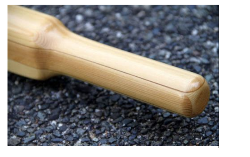 Here's another example of an uncomfortable grip. Notice the sharp transition of the grip to the loom. That edge will chafe the heal of your hand as you begin the pull stroke. 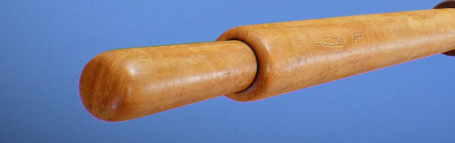 Pete Culler, another experienced recreational rower, prefers a "flared" grip. If the transition from the grip to the loom were smoothed and if the grip were lengthened to 5-1/2" or 6" from the drawn 5", it might be a pattern to consider. But as shown, that's another uncomfortable grip that going to cause chaffing. 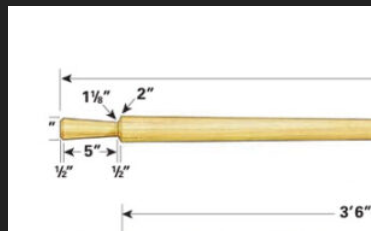 Here's one last example of a bad idea. That soft, spongy foam will trap heat from your hand muscles as they work. The heat will cause your hands to sweat. The heat and moisture will enable blisters to form. 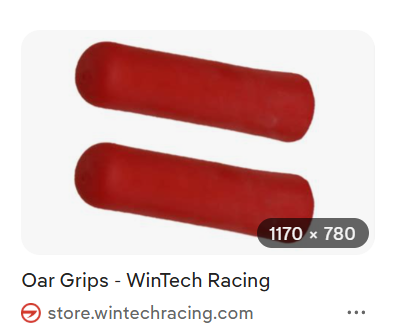 Finally, here's a very traditional grip shape that's actually a good choice, a "barrel" grip that's adequately transitioned into the loom. If the upper edge of the barrel is flattened slightly, a shape closer to a hammer handle turned sideways can be created which is very comfortable to use for allowing the oar to be "palmed" (rather rather gripped) on the recovery stroke, which gives fingers and forearm muscles a chance to relax before reengaging for the pull stroke. Also, the flattened upper surface provides tactical feedback so that blade orientation is never in doubt. If the upper surface is flat against your palm, you can know that the blade of the oar is vertical to the water without the need to visually confirm that is so. 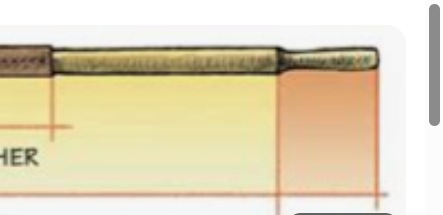 This should be your takeaway from the previous examples. The grip is your chief contact with the oar. It must be comfortable to your hands, or else rowing isn't fun. As I add to this thread, I'll deal with "oar balance', 'blade shapes', 'gearing ratios', etc. which are the things that can make rowing easy and fun or a miserable, regretted experience.  Happy fellow, right? even if he is rowing "backwards" and his oars are too short for that boat, which is another topic I'll get into, "proper" oar length vs what's likely to be more comfortable for those for whom rowing is casual recreation rather than timed competition. |
|
|
This post was updated on .
As I said previously, oar grips come in a variety of shapes, most of which are chosen for ease construction or are just a thoughtless copy of what's commonly found. The grip isn't shaped to create comfort for the hands, much less a specific pair of hands, which are yours. So let's try to fix that problem.
The three most common types of oar grips are 'broom stick' (favored by Bolger), 'flared' (favored by Culler), and 'barrel' (my preference for its being the most "ergonomic" as looking at your hands and seeing that your palm is hollowed will confirm). CLC's oar plans call for broomstick grips. 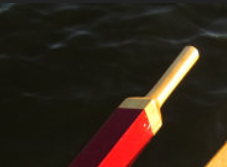 Here's an example of a Culler grip. 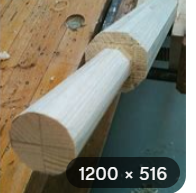 Here's a barrel grip whose transition from grip to loom is too abrupt and will chafe the heel of the hand on the reach stroke. 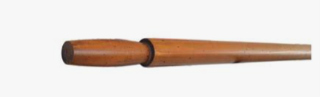
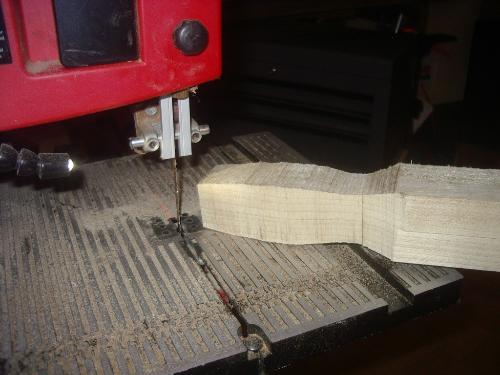
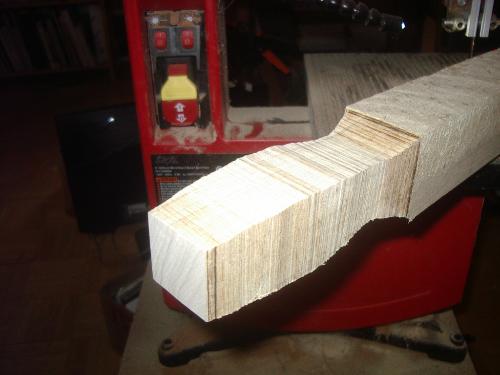
Here's a barrel grip with an acceptably tapered transition from grip to loom. 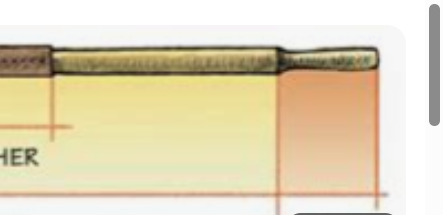 Oar plans specify grip lengths that vary from 5" to 6". I find that 5" isn't wide enough for me and 6" is unnecessarily wide. Something in the range of 5-1/2" to 5-5/8" is the middle ground that I find comfortable. But everyone's hands are a different size and shape, and what one person finds comfortable another won't. So the only way to choose what works best for you to try out different oars and then modify the grip on your own oars to match what you found to be comfortable. This is the grip half-pattern in profile that I prefer where I've superimposed two variations that have these things in common. Both are "barrels". Both assume a loom that is 2" square. Both use a deep "valley" to transition from the grip to the loom and where the heel of the hand fits comfortably as the oar is swung from the reach of the oar stroke to the release. 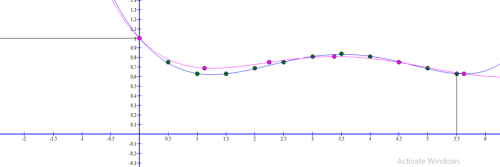 |
«
Return to RiversWest Forums
|
1 view|%1 views
| Free forum by Nabble | Edit this page |