An El Greco Nymph


 Locked


 
|
Bolger's Nymph, as he drew it, is 3'6" x 7'9". Shown below is the sailing version with its originally called for longitudinal thwarts (which seem like a good idea for being able to balance crew loads, but are very uncomfortable for single-user rowing).
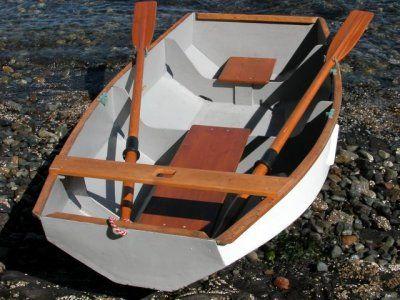 Many complain that Nymph is "tender", without fully realizing that --of course-- it is "tender", as would be predicted from its heavily-rockered, nearly-round hull, which is exactly why Nymph rows so easily and well. To correct its "tenderness", some widen the hull by as much as 12" and call that version, the Rubens Nymph, using an artsy metaphor. If Bolger's Nymph were to be extended in length, as I proposed to do, then an obvious name for that version would be an El Greco Nymph. So, here is the design problem: By how much could the original Nymph be extended without creating undue construction problems for having to scarf planks? From what I'm seeing from preliminary sketches, another 5" inches can be added to the boat's length at the cost of having to scarf just the sheer strake. A hull of that length would have a waterline length of 94" and a theoretical hull speed of 4.3 MPH (at 180 pounds displacement) which is plenty fast enough for a boat meant for fishing or casual recreational rowing. If more speed or burdensomeness were desired from the same keel-planked, double-knuckled hull shape, the hull could be made even longer, but at the cost of also having to scarf the garboard strake and/or the bottom plank. I'm willing to scarf one pair of planks, but not two plus the bottom. Also, given that I weigh just 120", I don't need a larger boat than even the original Nymph, which I've built twice, once following Payson's methods exactly and once using my own version of Stitch-and-Glue, which I call Position-and-Fillet. Below are my preliminary cutting patterns. As you can see, the boat can easily be cut from two sheets of ply. 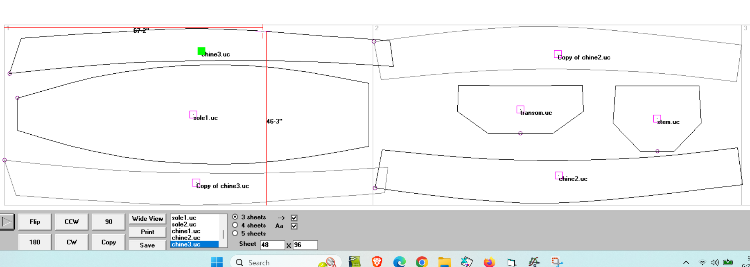 Bolger doesn't crown the bow or transom, nor does he scupper the gunnel, both of which are boat details I prefer. Also, I found his framing to be a flimsy clutter of the interior that is better avoided by using more traditional, minimalist frames. Also, I much prefer to double the skeg rather than use a single one, not because using a pair of them creates better underway directionality, but because they create stability when launching or beaching. My construction schedule looks like this. I need to get a currently-unfinished boat off the building frame and into my paint shop, plus prep for a work-party visit from my daughter in early August. Then I'll be free to start building my El Greco Nymph. My guess is that 20 to 30 hours of work should get me a hull ready to oil and varnish. That might seem unrealistically fast. But I've built at least a half dozen similar prams this way, i.e., dory style, right-side up, using just a single, mid-boat mold. So it's not as if I'm having to learn new skills or techniques. |
|
|
This post was updated on .
All lines have now been faired to the nearest 0.01", and a boat could be built using just this table of offsets.
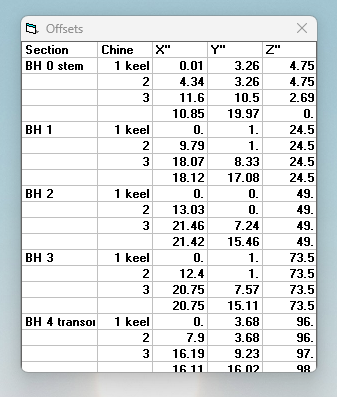 Below is that table of offsets plotted with a graphing program. The blue line is obviously the boat's sheer (in profile). The red line, its rocker. The line green line, its bottom plank (in plan view). And the purple line is its gunnel (in plan view). When a 2nd order, polynomial trendline can be passed through all points called out in each of the five stations of the table of offsets, you know you have a fair hull that lofting the boat will confirm. 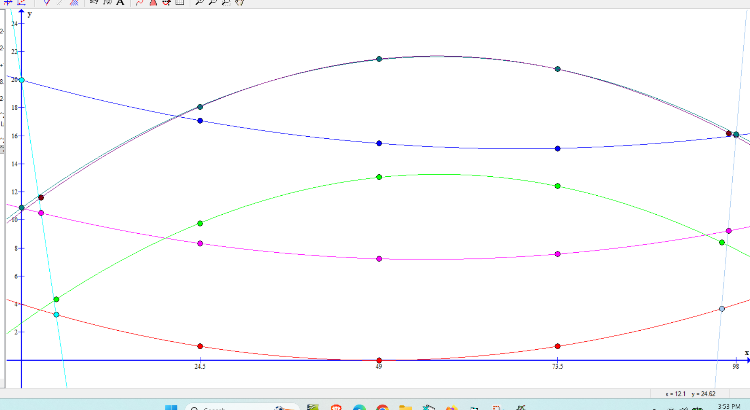 At 200 pounds displacement, which is boat weight, plus crew weight, plus gear weight, the nose is on the water, which I want to dampen porpoising, and the stern is clear. Such a displacement puts 89" inches on the waterline which suggests a theoretical hull speed of 4.2 MPH, which is plenty fast enough for fishing and casual, recreational rowing. 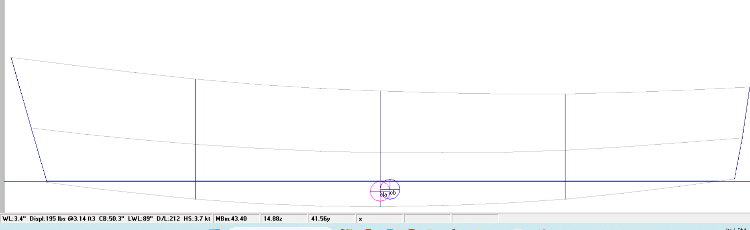
|
|
|
As can be inferred from the table of offsets, the boat's max beam is about 43", or only an inch wider than the original Nymph's 42" inches. The cutting patterns show that a much wider boat could be built. But I'm not sure I want a wider boat, and I certainly don't need more burdensomeness, since I never row with a second person in the boat.
Looking ahead a bit, what length oars might be a good match for the El Greco Nymph? As is widely known, Shaw & Tenney recommend 28% leverage and assume a 2" overlaps of the grips. Most people hate to row cross-handed, but I prefer it, and I'm flexible about how much grip overlap. The one thing I do insist on is 30% leverage, not less, not more. That means I'll be building a pair of balanced 6.75s to go with this boat. 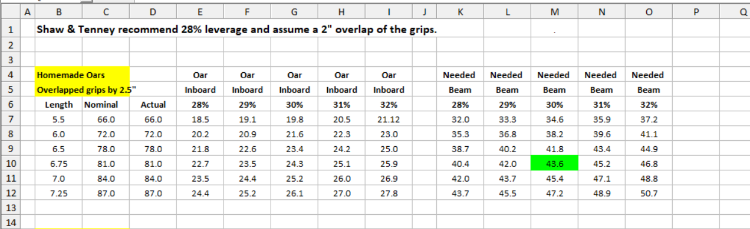
|
«
Return to RiversWest Forums
|
1 view|%1 views
| Free forum by Nabble | Edit this page |